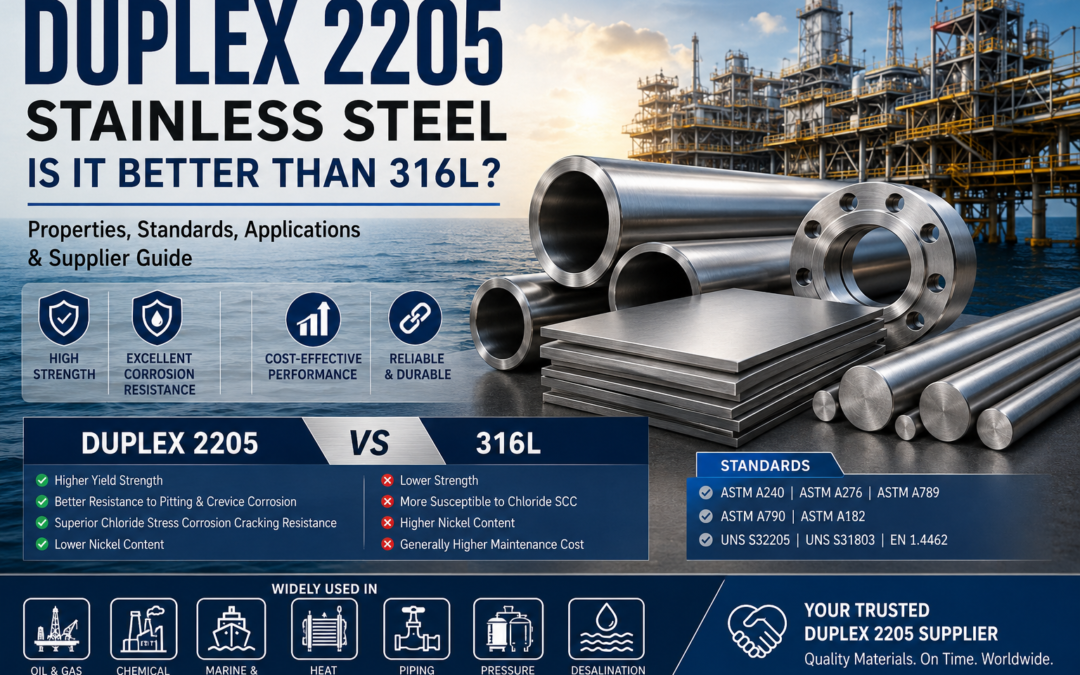
Duplex 2205 Stainless Steel: Is It Better Than 316L? Properties, Applications & Buying Guide
When engineers need stainless steel that combines high strength with strong corrosion resistance, Duplex 2205 is often one of the grades considered.
But is Duplex 2205 actually better than 316L?
The answer is not simply yes or no.
Duplex 2205 and 316L are designed around different performance priorities. Duplex 2205 can provide substantially higher mechanical strength and strong resistance to chloride-related corrosion, while 316L remains an established choice for many applications because of its austenitic structure, fabrication characteristics, availability, and broad industrial use.
For engineers and purchasing teams, the better question is:
Which material is better for the actual operating environment and design requirement?
This guide explains the differences between Duplex 2205 and 316L, the meaning of UNS S31803 and S32205, relevant standards, applications, purchasing considerations, and what to look for when selecting a Duplex 2205 stainless steel supplier.
What Makes Duplex 2205 Different?
Duplex 2205 belongs to the duplex stainless steel family, which combines ferritic and austenitic phases.
That mixed microstructure gives the alloy a different balance of properties from conventional austenitic stainless steels such as 304L and 316L.
The result is a material known for:
- High mechanical strength
- Strong resistance to chloride stress corrosion cracking
- Good resistance to pitting and crevice corrosion
- Good general corrosion resistance
- Useful resistance to erosion-corrosion
- Good weldability when properly processed
Industry datasheets describe Duplex 2205 as having high mechanical strength together with strong resistance to stress corrosion cracking, pitting, crevice corrosion, erosion corrosion, and corrosion fatigue.
This combination is one of the main reasons 2205 is widely considered for demanding industrial service.
Duplex 2205 Designations: S31803, S32205 and 1.4462
One of the most common sources of confusion when purchasing 2205 is the use of several designations.
You may encounter:
- Duplex 2205
- UNS S31803
- UNS S32205
- EN 1.4462
- X2CrNiMoN22-5-3
- W.Nr. 1.4462
S31803 and S32205 are both associated with the 2205 family, but they should not simply be treated as interchangeable specifications.
S32205 has tighter composition requirements, particularly for chromium, molybdenum, and nitrogen.
For example, published data show S32205 with a tighter upper-end alloying range than S31803.
Setelah menjelaskan S31803, tambahkan:
For a more detailed discussion of Duplex 2205 / UNS S31803, see our earlier guide: Duplex Stainless Steel AISI 2205 UNS S31803.
Blok:
What does this mean for buyers?
If a purchase order says only:
“Duplex 2205”
that may not provide enough information.
A better purchasing specification identifies:
UNS designation + product form + applicable standard + dimensions + certification requirements.
For example:
UNS S32205 — ASTM A276 — Round Bar — Ø50 mm × 3,000 mm — MTC required
This gives the supplier much clearer information about what is required.
Duplex 2205 vs 316L: Which One Should You Choose?
This is one of the most useful comparisons for engineers and buyers.
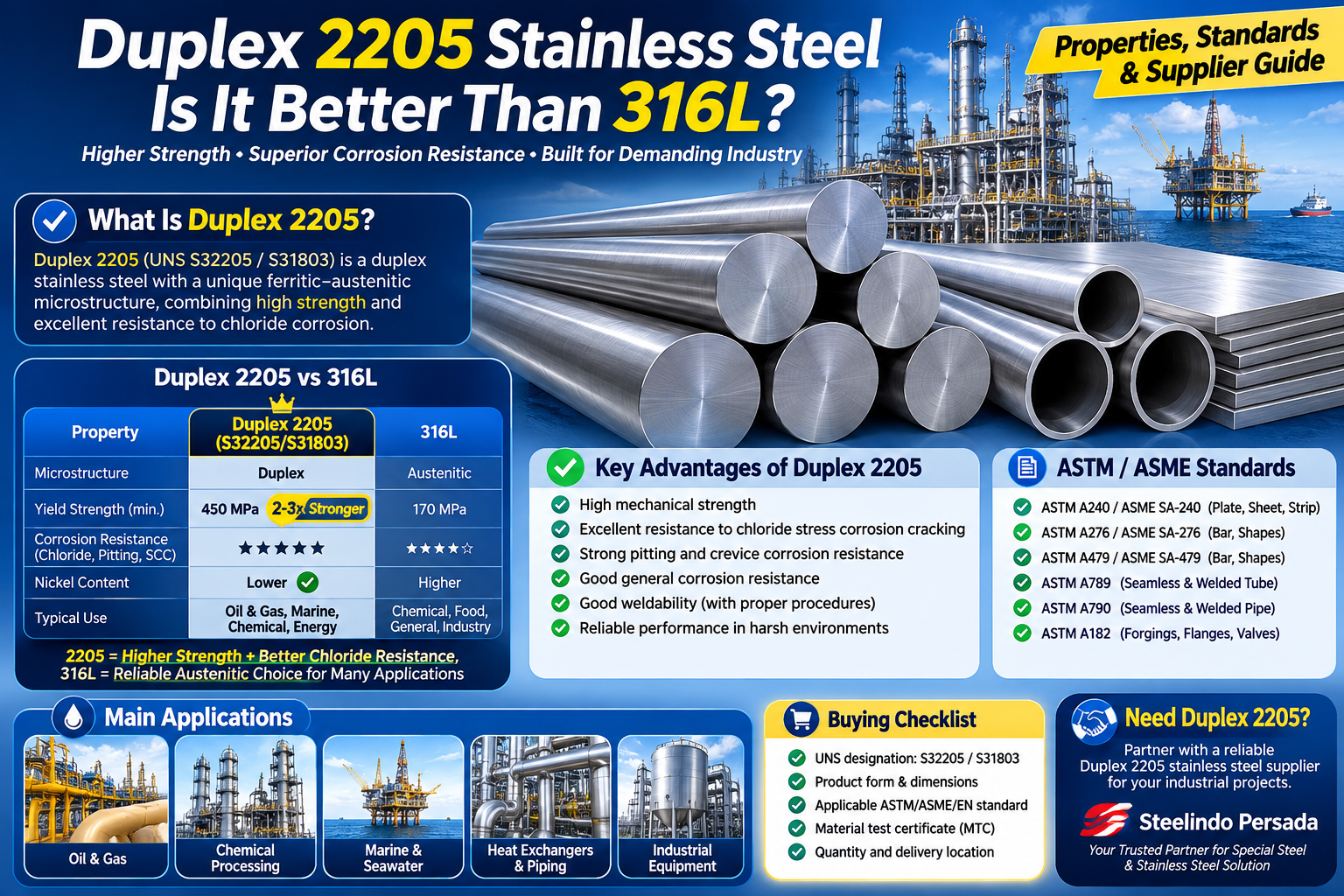
| Characteristic | Duplex 2205 | 316L |
|---|---|---|
| Stainless steel family | Duplex | Austenitic |
| Microstructure | Ferritic + austenitic | Austenitic |
| Mechanical strength | High | Moderate |
| Chloride SCC resistance | Strong | More limited |
| Pitting/crevice resistance | Strong | Good |
| Nickel content | Lower than 316L | Higher |
| Typical industrial use | Oil & gas, chemical, marine, energy | Chemical, food, pharmaceutical, general industry |
| Material selection | Strength + corrosion resistance | Versatility + established fabrication |
Published comparison data show that 2205 can have much higher minimum proof/yield strength than 316L. For example, one Outokumpu comparison lists 450 MPa minimum proof strength for both S31803 and S32205, compared with 170 MPa for S31603 under the cited conditions.
That difference can be important when designing pressure-containing or structural components.
But higher strength does not automatically make 2205 the better material.
316L can still be the appropriate choice when:
- Austenitic material behavior is preferred
- Fabrication requirements favor 316L
- The corrosion environment does not justify upgrading to duplex
- Existing project specifications require 316L
- Availability or procurement considerations favor 316L
- The application is already qualified around 316L
The correct material is the one that satisfies the complete engineering requirement—not necessarily the one with the highest strength.
Why Corrosion Environment Matters
The biggest mistake in stainless steel selection is choosing a grade based only on its name.
A material that performs well in one environment may not be the best choice in another.
For Duplex 2205, important factors include:
- Chloride concentration
- Temperature
- pH
- Pressure
- Fluid chemistry
- Exposure time
- Welding condition
- Surface condition
- Fabrication history
Chromium, molybdenum, and nitrogen contribute significantly to localized corrosion resistance. Published data also show a higher pitting-resistance equivalent number for 2205 than for 316L under the referenced comparison.
Therefore, material selection should always be based on the actual operating environment.
Duplex 2205 Chemical Composition
The exact chemical limits depend on the applicable specification.
Typical alloying elements include:
- Chromium: approximately 22%
- Nickel: approximately 5%
- Molybdenum: approximately 3%
- Nitrogen: approximately 0.15–0.20%
- Carbon: low
- Manganese and silicon: controlled
- Iron: balance
For example, an Alleima 2205 datasheet gives nominal values of approximately 22.5% Cr, 5.5% Ni, 3.2% Mo and 0.18% N for its product, while published Outokumpu data show specification-dependent composition ranges for S31803 and S32205.
This is why a supplier quotation should identify the applicable standard instead of relying solely on a generic “2205” description.
Mechanical Strength: One of 2205’s Major Advantages
Duplex 2205 is attractive when the component needs both corrosion resistance and mechanical strength.
Compared with 316L, its higher yield strength can provide design advantages.
In the cited ASME comparison, S31803 and S32205 are listed at 450 MPa minimum yield strength, while S31603 is listed at 170 MPa under the referenced conditions.
This does not mean every 2205 product will have exactly the same mechanical properties.
Actual values depend on:
- Product form
- Thickness or diameter
- Heat treatment
- Applicable standard
- Testing condition
- Manufacturing route
Always use the material certificate and applicable product specification for final engineering decisions.
ASTM and ASME Standards for Duplex 2205
Different product forms can fall under different standards.
Common examples include:
Plate, Sheet and Strip
ASTM A240 / ASME SA-240
Bar and Shapes
ASTM A276 / ASME SA-276
ASTM A479 / ASME SA-479
Pipe
ASTM A790
Tube
ASTM A789
Forgings, Flanges and Related Components
ASTM A182
Published manufacturer data identify these standards for relevant 2205 product forms, including A240, A276, A479, A789, A790 and A182.
The correct standard should always be confirmed against the engineering specification and intended application.
Where Is Duplex 2205 Used?
The value of 2205 becomes clearer when looking at the environments where it is used.
Oil and Gas
Applications can include:
- Process piping
- Flanges
- Valves
- Tubes
- Offshore components
- Pressure-containing equipment
- Production equipment
Outokumpu specifically lists oil and gas applications including flanges, valves, tubes and pipes for its 2205 product.
For sour-service applications, additional requirements may apply, including NACE/ISO specifications depending on the project.
Chemical Processing
Chemical plants can expose equipment to aggressive fluids and elevated chloride levels.
Potential applications include:
- Process tanks
- Piping
- Heat exchangers
- Pumps
- Valves
- Chemical handling equipment
The actual suitability depends on the chemical composition and operating conditions.
Marine and Seawater Systems
Chloride exposure is one reason duplex stainless steels are attractive for marine environments.
Possible applications include:
- Seawater piping
- Marine equipment
- Offshore systems
- Desalination equipment
- Pumps
- Heat exchangers
However, “marine” alone is not a sufficient material specification. Temperature, oxygen level, flow velocity, crevices, deposits, and fabrication condition should also be considered.
Heat Exchangers and Piping
Heat exchangers and piping often require a combination of:
strength + corrosion resistance + dimensional reliability + weldability.
Duplex 2205 can be considered when these requirements are present.
The appropriate product standard depends on whether the buyer needs plate, tube, pipe, bar, or fabricated components.
When 2205 May NOT Be the Best Choice
A useful material-selection guide should also explain when not to choose the material.
Duplex 2205 may not automatically be the right answer when:
- The project specification explicitly requires 316L
- The service environment is better suited to an austenitic grade
- Fabrication procedures have only been qualified for another material
- Operating temperatures exceed the appropriate design range
- The application requires a different corrosion-resistance level
- The project requires a super duplex grade instead
- Availability of the required product form is limited
In other words:
Do not upgrade from 316L to 2205 simply because 2205 has higher strength.
The entire application must be evaluated.
This is also where working with an experienced Duplex 2205 supplier can be useful.
Duplex 2205 Price: What Actually Drives the Cost?
Searching for Duplex 2205 price is only the beginning.
Two products with the same nominal grade can have very different prices.
Important factors include:
Product Form
Plate, bar, pipe, tube, forging, and machined components have different production costs.
Dimensions
Large diameters, heavy sections, unusual thicknesses, or special dimensions may require different manufacturing routes.
Quantity
Mill quantities and small project quantities can have very different pricing structures.
Certification
Requirements for MTCs, third-party inspection, PMI, testing, or special documentation can affect total cost.
Standard
ASTM, ASME, EN, NACE, NORSOK, and project-specific requirements may influence sourcing options.
Machining
Finished components naturally cost more than raw material.
Logistics
Freight, packing, insurance, customs, and delivery destination can materially affect the landed cost.
Therefore, comparing only the price per kilogram may produce a misleading result.
For procurement teams, the more useful number is often the total delivered cost that meets the required specification.
How to Buy Duplex 2205 With Less Risk
Before contacting a supplier, prepare a clear material requirement.
A useful RFQ should include:
Grade: UNS S32205 / S31803
Product: Round bar / plate / pipe / tube / etc.
Standard: ASTM / ASME / EN
Dimensions: Diameter, thickness, width, length
Quantity: Pieces or total weight
Condition: Heat treatment or delivery condition
Certification: MTC / EN 10204 3.1 or project requirement
Testing: PMI, mechanical, corrosion or third-party testing if required
Destination: Country and delivery location
Required delivery: Target date
This allows a Duplex 2205 stainless steel supplier to evaluate the requirement more accurately.
Choosing a Duplex 2205 Stainless Steel Supplier
A reliable supplier should be evaluated on more than price.
Ask:
Can the supplier identify the exact UNS grade?
“2205” alone is not always enough.
Can the supplier provide material certification?
For industrial applications, documentation and traceability can be critical.
Can the supplier identify the applicable product standard?
A supplier should understand why A240, A276, A789, A790, A182, or another specification may apply to different product forms.
Can the supplier support international sourcing?
For buyers outside the supplier’s domestic market, documentation, packing, shipping, and delivery arrangements matter.
Can the supplier understand the application?
A supplier who understands the technical requirement can help reduce the risk of purchasing a material that does not meet the project’s actual needs.
Sourcing Duplex 2205 for the USA, Mexico, Saudi Arabia and Indonesia
Duplex 2205 is relevant to multiple industrial markets.
United States
US buyers may require ASTM, ASME, NACE, project specifications, or customer-specific documentation.
Mexico
Manufacturing, energy, chemical processing, fabrication, and industrial equipment projects can require corrosion-resistant stainless steel with high mechanical strength.
Saudi Arabia
Oil and gas, petrochemical, desalination, marine, and energy projects can create demanding material requirements where duplex stainless steel may be considered.
Indonesia
Energy, marine, chemical processing, manufacturing, engineering, and industrial projects can also require Duplex 2205 in different product forms.
For international sourcing, the best starting point is not the country name.
It is the technical specification.
Once the grade, product form, dimensions, quantity, certification, and delivery location are clear, a supplier can provide a more meaningful quotation.
Duplex 2205 Buying Checklist
Before placing an order, confirm:
- UNS designation
- Product form
- Applicable ASTM/ASME/EN standard
- Dimensions
- Quantity
- Heat-treatment condition
- Chemical composition
- Mechanical properties
- Material test certificate
- Required inspection/testing
- Traceability requirements
- Delivery terms
- Final destination
A clear checklist can prevent a surprisingly common purchasing problem:
receiving a material that is called “2205” but does not match the complete project specification.
Final Answer: Is Duplex 2205 Better Than 316L?
Sometimes yes.
Sometimes no.
Duplex 2205 can be the stronger choice when high mechanical strength, chloride stress corrosion cracking resistance, and localized corrosion resistance are important.
316L can remain the better choice when its austenitic characteristics, established fabrication practices, availability, or project requirements make it more appropriate.
The right question is therefore not:
“Which stainless steel is better?”
It is:
“Which stainless steel is the right fit for this application?”
That distinction can save money, reduce material-selection risk, and improve long-term equipment performance.
Need a Duplex 2205 Stainless Steel Supplier?
If your project requires Duplex 2205 / UNS S32205 / UNS S31803, provide the required product form, dimensions, quantity, applicable standard, certification requirements, and delivery destination.
Steelindo Persada can evaluate your material requirement and provide further information for your sourcing needs.
Request a Duplex 2205 quotation for your project today.