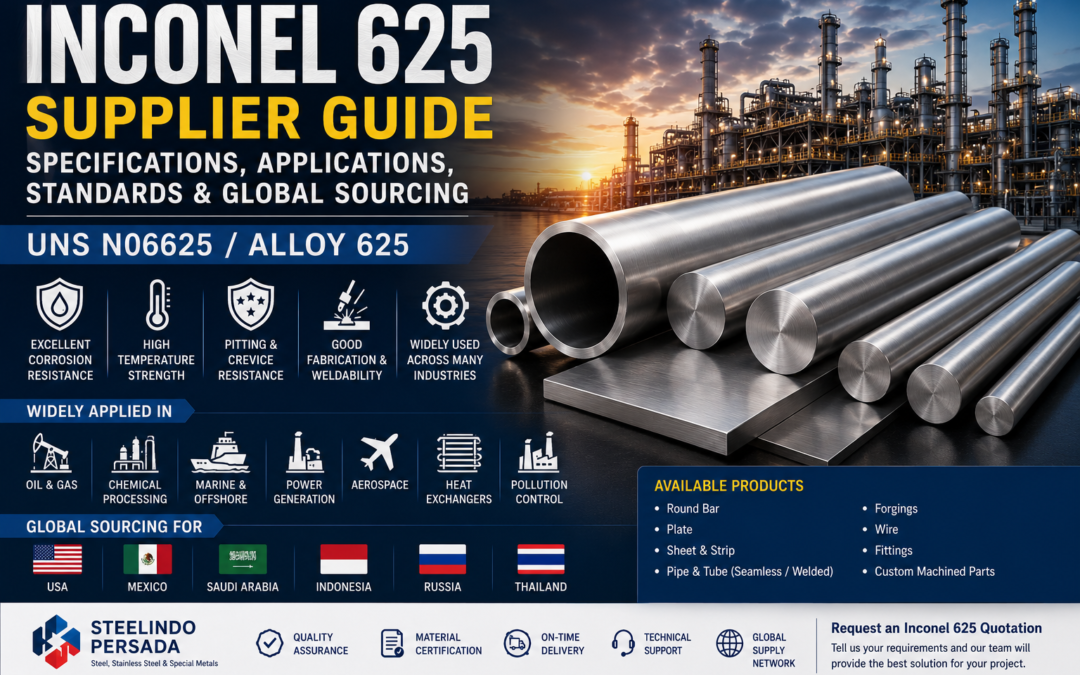
Finding the right Inconel 625 supplier is important when a component must withstand high temperatures, corrosive environments, pressure, and demanding industrial service conditions.
Also known as Alloy 625 and UNS N06625, this nickel-based alloy is widely considered for applications where high strength, corrosion resistance, and reliable performance in demanding environments are required.
When you are buying a high-performance nickel alloy, the cheapest quotation is rarely the only thing that matters. Material specification, certification, product form, dimensions and delivery capability can have just as much impact on the success of an industrial project.
A material may look right on paper, but the real question is whether the grade, product form, dimensions, specification, certification and condition actually match the requirements of your project.
This is particularly important when sourcing Inconel 625, also known as Alloy 625 or UNS N06625.
Inconel 625 is a nickel-chromium-molybdenum alloy with niobium that combines high strength with excellent resistance to a wide range of corrosive environments. It is used in demanding applications ranging from chemical processing and marine equipment to oil and gas, aerospace and power generation.
For buyers in the United States, Mexico, Saudi Arabia, Indonesia, Russia, Thailand and other industrial markets, choosing the right supplier starts with understanding exactly what you need.
This guide walks through the material, common specifications, applications, product forms, price factors and practical considerations when sourcing Inconel 625.
What Is Inconel 625?
Inconel 625 is a nickel-based alloy containing chromium, molybdenum and niobium as important alloying elements.
Its strength comes primarily from the stiffening effect of molybdenum and niobium in the nickel-chromium matrix, while the alloy chemistry contributes to its resistance to corrosion and high-temperature oxidation.
The material is commonly identified as:
- Inconel 625
- Alloy 625
- Nickel Alloy 625
- UNS N06625
- W.Nr. 2.4856
The last two designations are particularly useful when communicating technical requirements with a supplier. Special Metals identifies Inconel Alloy 625 as UNS N06625 / W.Nr. 2.4856.
However, specifying only “Inconel 625” is not always enough for a purchase order.
The supplier also needs to know the product form and applicable specification.
Why Choose Inconel 625?
Inconel 625 is generally selected when a project requires a combination of corrosion resistance, strength, fabrication characteristics and performance in demanding environments.
Excellent Corrosion Resistance
One of the strongest reasons for considering Alloy 625 is its resistance to a broad range of corrosive environments.
It is particularly noted for resistance to pitting, crevice corrosion and chloride-ion stress-corrosion cracking, which helps explain its use in marine and offshore applications.
High Strength
Molybdenum and niobium contribute to the alloy’s strength without requiring a conventional precipitation-hardening treatment.
This combination can make Inconel 625 attractive when designers need substantial strength together with corrosion resistance.
High-Temperature Performance
Inconel 625 is capable of service across a broad temperature range, depending on the application, loading conditions and applicable design requirements. Special Metals describes the alloy as having useful service capability from cryogenic temperatures to elevated temperatures approaching 982°C in appropriate applications.
That does not mean every Inconel 625 component can simply be operated at that temperature.
Actual allowable temperature should always be established from the applicable design code, product specification and operating conditions.
Good Fabrication and Joining Characteristics
Inconel 625 is also known for good fabricability and joining characteristics.
This makes it practical for a wide variety of fabricated components when suitable procedures and tooling are used.
Inconel 625 Chemical Composition
The chemistry of Inconel 625 is central to its performance.
Typical specification limits include:
| Element | Typical specification range/limit | ||||||||
|---|---|---|---|---|---|---|---|---|---|
| Nickel | 58.0% min. | ||||||||
| Chromium | 20.0–23.0% | Molybdenum | 8.0–10.0% | Niobium + Tantalum | 3.15–4.15% | Iron | 5.0% max. | ||
These values are based on commonly published Alloy 625 composition requirements; the exact requirements should always be checked against the specification and revision applicable to the purchased product.
For an industrial purchase, the Material Test Certificate (MTC) should be checked against the applicable specification.
Inconel 625 Mechanical Properties
Mechanical properties depend on the product form, size, processing route, heat treatment and applicable specification.
For example, published data for bar products can differ from values for plate or other product forms. ATI’s published data for ATI 625 bar gives minimum tensile and yield requirements that differ from generic datasheet values found elsewhere.
Important properties to evaluate may include:
- Tensile strength
- Yield strength
- Elongation
- Hardness
- Density
- Fatigue performance
- High-temperature mechanical properties
The density of Alloy 625 is approximately 8.44 g/cm³ according to published manufacturer data.
Why Does Product Form Matter?
A common purchasing mistake is to take a mechanical-property number from a general Inconel 625 datasheet and assume it applies to every product.
It does not.
A bar, plate, tube, forging or fabricated component may be covered by different requirements.
For critical applications, always refer to the applicable material specification and MTC rather than relying solely on a general online datasheet.
Inconel 625 vs 316L Stainless Steel
One of the most practical questions during material selection is:
Should you use Inconel 625 or 316L stainless steel?
There is no universal answer.
316L is a highly versatile stainless steel and is often an economical choice for general corrosion-resistant applications.
Inconel 625 is a nickel-based alloy intended for more demanding combinations of corrosion, strength and temperature requirements.
| Factor | Inconel 625 | 316L Stainless Steel |
|---|---|---|
| Alloy family | Nickel-based alloy | Austenitic stainless steel |
| Corrosion resistance | Excellent in many aggressive environments | Good to excellent depending on environment |
| Chloride exposure | Strong resistance | More limited in severe conditions |
| High-temperature applications | Strong candidate | More limited depending on service |
| Material cost | Generally higher | Generally lower |
| Typical applications | Severe industrial, marine, chemical, aerospace | General industrial, chemical, food, pharmaceutical |
The important point is that more expensive does not automatically mean better.
If 316L safely meets the service requirements, using Inconel 625 may not provide enough additional value to justify the higher material cost.
The right material is the one that satisfies the actual engineering requirements.
Inconel 625 vs Hastelloy C-276
Inconel 625 and Hastelloy C-276 are both nickel-based alloys used in demanding corrosion environments.
However, they have different compositions and are not interchangeable simply because both are nickel alloys.
When comparing them, engineers should consider:
- Process chemistry
- Temperature
- Chloride concentration
- Corrosion mechanism
- Mechanical requirements
- Welding requirements
- Applicable code
- Product availability
- Total project cost
For particularly aggressive chemical environments, material selection should be based on the actual process conditions rather than a generic “best alloy” ranking.
Inconel 625 ASTM, ASME and AMS Standards
The applicable standard depends on the product form and project requirements.
Commonly encountered specifications include:
| Standard | Typical product/application |
|---|---|
| ASTM B443 | Plate, sheet and strip |
| ASTM B444 | Seamless pipe and tube |
| ASTM B446 | Bar and related products |
| ASTM B564 | Forgings |
| ASTM B704/B705 | Welded pipe/tube applications |
| AMS 5599 | Sheet, strip and plate applications |
| AMS 5666 | Bar, forgings and related aerospace products |
ASME may use corresponding SA/SB specifications depending on the applicable code section and material requirement. Published material references list, for example, ASME SB-443, SB-444, SB-446 and SB-564 for applicable forms.
The critical point is:
Do not specify a standard simply because it appears on a general Inconel 625 datasheet. Match the standard to the product form and project requirement.
Inconel 625 Product Forms
Depending on the supplier and applicable specification, Inconel 625 may be sourced in different forms.
Round Bar
Used for machining, shafts, fasteners, valve components and other engineered parts.
Plate
Suitable for fabricated equipment and industrial components where thicker material sections are required.
Sheet and Strip
Used for fabrication and applications requiring thinner sections.
Pipe and Tube
Used for fluid handling, heat transfer and specialized process systems.
Forgings
Used for components requiring specific shapes and mechanical properties.
Wire
Used for specialized fabrication and welding-related applications.
Machined Components
Some buyers need a finished or semi-finished component rather than raw material.
When requesting a quotation, always identify the required product form.
Inconel 625 Applications
The combination of strength and corrosion resistance makes Inconel 625 relevant to many industries.
Common applications include:
- Oil and gas equipment
- Chemical processing equipment
- Marine systems
- Offshore equipment
- Heat exchangers
- Piping systems
- Valves
- Aerospace components
- Power-generation equipment
- Pollution-control equipment
- Specialized fabricated components
Manufacturer information also lists applications including aerospace, gas turbines, chemical processing, oil and gas extraction, pollution control, marine and nuclear engineering.
Oil and Gas
Oil and gas equipment can combine pressure, temperature and corrosive fluids.
Inconel 625 may be considered for applications such as:
- Valves
- Offshore components
- Piping components
- Downhole equipment
- Wellhead-related components
- Fasteners
- Specialized oilfield equipment
The applicable project specification should always be confirmed, especially when additional sour-service requirements apply.
Chemical Processing
Chemical-processing equipment can encounter aggressive fluids and elevated temperatures.
Potential applications include:
- Heat exchangers
- Reaction vessels
- Process piping
- Valves
- Pumps
- Specialized tanks
- Transfer equipment
The actual suitability depends on the chemical composition, concentration, pressure and temperature of the process.
Marine and Offshore
Seawater environments can be challenging because of chloride exposure.
Inconel 625 has been used in marine applications because of its resistance to pitting, crevice corrosion and chloride-related stress corrosion cracking.
Potential applications include:
- Seawater equipment
- Offshore components
- Subsea-related equipment
- Marine fittings
- Heat-transfer components
- Specialized fasteners
Aerospace
Aerospace applications place strong demands on material quality and traceability.
Inconel 625 is used in selected aerospace applications where its combination of strength, corrosion resistance and high-temperature capability is appropriate.
Depending on the project, buyers may require specific AMS specifications, testing, certification and traceability.
Inconel 625 Welding and Fabrication
Inconel 625 has good welding and fabrication characteristics, which contributes to its usefulness in engineered components.
However, nickel alloys should not simply be fabricated using exactly the same practices used for ordinary carbon steel.
Machining and fabrication may require attention to:
- Tool selection
- Cutting speed
- Feed rate
- Heat generation
- Work hardening
- Surface condition
- Welding procedure
For critical welded components, the applicable welding procedure and filler material should be established according to the project requirements.
Inconel 625 Price: What Affects the Cost?
Searching for Inconel 625 price can produce very different results.
That is because the material price is influenced by much more than the alloy designation.
Product Form
Bar, plate, sheet, pipe, tube and forgings have different manufacturing routes.
Dimensions
Special dimensions may require additional processing or may have limited availability.
Quantity
A small quantity and a large industrial order can have very different pricing structures.
Specification
ASTM, ASME, AMS and customer-specific requirements can influence the cost.
Certification
MTCs, inspection, testing, PMI and third-party documentation can affect the final quotation.
Machining
A machined component naturally costs more than raw stock.
Freight and Destination
For international buyers, freight, insurance, customs and delivery terms can significantly affect landed cost.
Therefore, comparing only price per kilogram can produce a misleading result.
A better comparison is:
Material + specification compliance + certification + logistics + delivery reliability.
How to Choose an Inconel 625 Supplier
Choosing an Inconel 625 supplier is ultimately about reducing purchasing risk.
Before ordering, ask the supplier:
Can you supply the required specification?
Make sure the quotation identifies the applicable standard.
Can you provide material certification?
For industrial projects, the required MTC should normally include appropriate traceability and test information.
Can you supply the required dimensions?
Confirm diameter, thickness, width, length and tolerance requirements.
Can you provide the required product form?
A supplier may have Inconel 625 available but not in the form needed for your project.
Can you support international delivery?
For international sourcing, confirm packing, freight, documentation, delivery terms and destination requirements.
Global Inconel 625 Sourcing
International sourcing can provide buyers with more options when local availability does not match the required specification, product form or quantity.
However, the country of origin or destination should never replace technical specification when comparing suppliers.
Inconel 625 Supplier for USA
US buyers may encounter requirements based on:
- ASTM
- ASME
- AMS
- NACE
- Customer-specific specifications
For aerospace applications, the required AMS specification and traceability should be confirmed before ordering.
For oil and gas or pressure-related projects, the applicable code and project requirements should be clearly stated in the RFQ.
Inconel 625 Supplier for Mexico
Mexico has substantial manufacturing, energy and industrial activity.
When sourcing Inconel 625 for Mexico, buyers should provide:
- UNS N06625
- Product form
- Dimensions
- Quantity
- Applicable specification
- Certification requirements
- Delivery location
This helps suppliers compare the requirement accurately rather than providing a generic price for “Inconel 625.”
Inconel 625 Supplier for Saudi Arabia
Saudi Arabia has major demand across industries such as:
- Oil and gas
- Petrochemical
- Energy
- Desalination
- Marine
- Industrial processing
For these applications, buyers may have additional requirements concerning inspection, documentation, traceability and project-specific specifications.
Inconel 625 Supplier for Indonesia
In Indonesia, Inconel 625 can be relevant to:
- Energy
- Chemical processing
- Marine industries
- Industrial manufacturing
- Engineering projects
For imported material, buyers should consider the total landed cost, not only the supplier’s material price.
Inconel 625 Supplier for Russia
Russian buyers sourcing Inconel 625 should clearly identify the material as UNS N06625 / W.Nr. 2.4856 where applicable, together with the required product form and specification.
The quotation should also address:
- Material certification
- Dimensions
- Quantity
- Applicable international standard
- Import documentation
- Customs requirements
- Shipping route
- Delivery terms
Because international trade conditions, logistics routes and import requirements can change, these commercial details should be confirmed for the specific order before purchase.
Inconel 625 Supplier for Thailand
Thailand has a broad manufacturing and industrial supply market, including demand for nickel alloys in sectors such as energy, chemical processing, marine and specialized manufacturing.
For Thai buyers, an RFQ should clearly state:
- Inconel 625 / UNS N06625
- Product form
- Dimensions
- ASTM/ASME/AMS requirement
- Quantity
- Certification
- Inspection requirements
- Delivery location
For Southeast Asian projects, buyers may also compare availability, lead time, freight and total delivered cost when evaluating international supply options.
How to Request an Inconel 625 Quotation
A clear RFQ can save considerable time.
Instead of writing:
“Please quote Inconel 625.”
provide something closer to:
Material: Inconel 625 / UNS N06625
Product form: Round bar
Standard: ASTM B446
Diameter: 50 mm
Length: 3,000 mm
Quantity: 20 pieces
Certification: Required MTC
Inspection: If applicable
Destination: Thailand
Required delivery: [date]
The supplier can then evaluate the actual requirement rather than guessing what the buyer needs.
Inconel 625 RFQ Checklist
Before sending your inquiry, check the following:
| Requirement | Information to provide |
|---|---|
| Grade | Inconel 625 / UNS N06625 |
| Product form | Bar / plate / sheet / pipe / tube / forging |
| Dimensions | Diameter / thickness / width / length |
| Quantity | Pieces / kg / tons |
| Specification | ASTM / ASME / AMS / project specification |
| Condition | As required |
| Certification | MTC / inspection documents |
| Testing | If required |
| Destination | Country and delivery location |
| Schedule | Required delivery date |
The more complete the RFQ, the easier it is to prepare a meaningful quotation.
Common Mistakes When Buying Inconel 625
Buying Only by Price
A low price may reflect a different specification, product condition or certification level.
Specifying Only the Alloy Name
“Inconel 625” does not tell the supplier everything needed to quote the material.
Ignoring Product Form
Bar, plate, pipe, tube and forgings can have different applicable standards.
Not Checking the MTC
The certificate should be reviewed against the purchase specification.
Comparing Non-Equivalent Quotations
Two suppliers may quote “Inconel 625” but use different standards, dimensions, quantities, certification or delivery terms.
The quotations should be normalized before comparing prices.
Frequently Asked Questions
Is Inconel 625 the same as UNS N06625?
Yes. UNS N06625 is the UNS designation associated with Inconel Alloy 625. W.Nr. 2.4856 is another commonly used material designation.
Is Inconel 625 stainless steel?
No.
Inconel 625 is a nickel-based alloy, not a conventional stainless steel.
Is Inconel 625 suitable for seawater?
It can be suitable for many seawater applications because of its strong resistance to localized corrosion and chloride-related corrosion mechanisms. Actual suitability depends on the service conditions and project requirements.
Is Inconel 625 more expensive than 316L?
Generally, yes. Inconel 625 is a nickel-based high-performance alloy and normally carries a higher material cost than 316L.
However, the actual price depends on product form, dimensions, quantity, specification, certification, availability and delivery.
What is the most important information for an Inconel 625 quotation?
At minimum:
UNS N06625 + product form + dimensions + quantity + applicable specification + certification requirements + destination.
Final Thoughts: Finding the Right Inconel 625 Supplier
Choosing an Inconel 625 supplier is not simply a matter of finding the lowest price.
The better starting point is to understand the application and define the material requirement clearly.
Is the component exposed to seawater?
High temperature?
Chlorides?
Chemical processing fluids?
Pressure?
Repeated thermal cycles?
The answers help determine whether Inconel 625 is appropriate and which product specification should be requested.
For buyers in the USA, Mexico, Saudi Arabia, Indonesia, Russia, Thailand and other international markets, a well-prepared technical RFQ makes the sourcing process much easier.
A good supplier should be able to discuss the grade, product form, applicable standard, dimensions, certification, traceability and delivery requirements rather than simply offering a price.
Request an Inconel 625 Quotation
Looking for Inconel 625 / UNS N06625 for your industrial project?
Send Steelindo Persada your:
- Required product form
- Dimensions
- Quantity
- Applicable ASTM, ASME or AMS specification
- Certification requirements
- Delivery destination
- Required delivery schedule
Steelindo Persada can review your requirement and provide further information and a quotation based on your project needs.